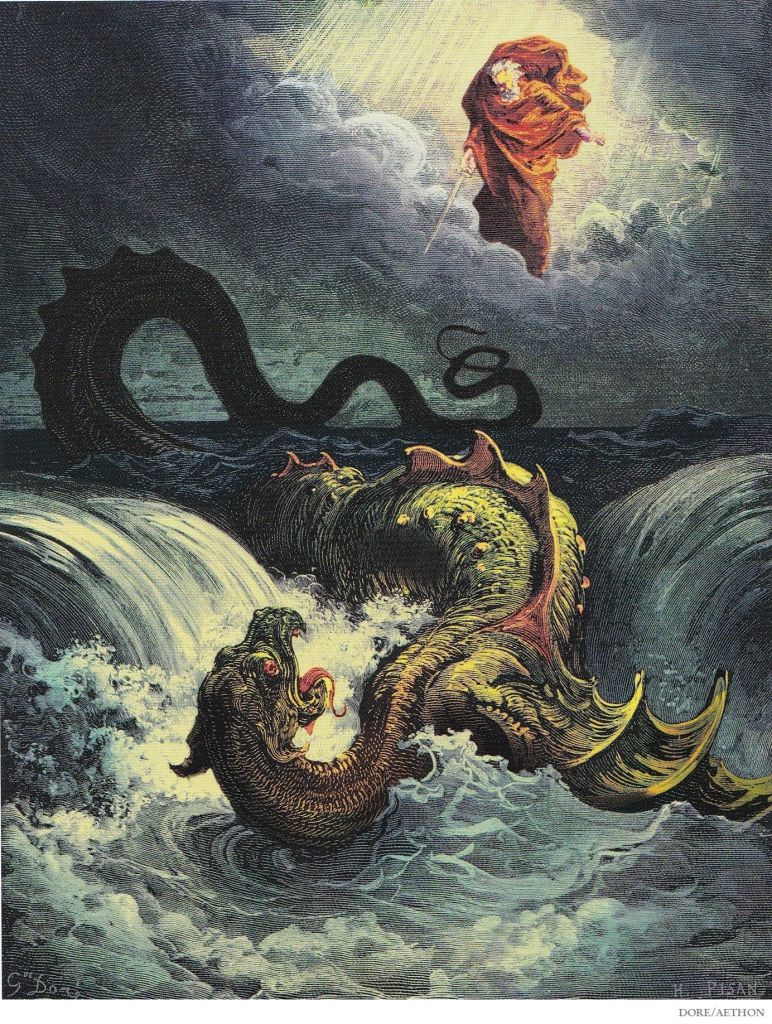
The Destruction of Leviathan, Gustave Dore, 1865.
Isaiah 27:1 On that day, the LORD with his cruel and great and strong sword will punish Leviathan the fleeing serpent, Leviathan the twisting serpent, and he will kill the dragon that is in the sea.
Psalm 74:13 You divided the sea by your might; you broke the heads of the dragons in the waters. 14 You crushed the heads of Leviathan; You gave him as food for the creatures of the wilderness.
Job 41:1 Can you draw out Leviathan with a fishhook, or press down its tongue with a cord? 19 From its mouth go flaming torches; sparks of fire leap out. 20 Out of its nostrils comes smoke, as from a boiling pot and burning rushes. 21 Its breath kindles coals, and a flame comes out of its mouth.
41:25 When it raises itself up the gods are afraid; at the crashing they are beside themselves. 33 On earth it has no equal, a creature without fear.
The Hebrew Bible often speaks of a sea monster, Leviathan, in terms reminiscent of a Dragon. Many Christian readers are led to seek a zoological explanation, that is, to identify Leviathan with known animals. Theories have been proposed, ranging from crocodiles to hippopotamuses.
However, these attempts are less than satisfying when the biblical data is taken seriously. Leviathan is said to have multiple heads (Psalm 74:14), breathe fire (Job 41:18-21), and is called a “dragon” explicitly (Isaiah 27:1). Not even a dinosaur would fit this description.
Many who trust the bible are puzzled by this. Leviathan reeks of pagan mythology. Did there once exist a seven-headed creature that breathed fire? If we truly believe the bible, must we also believe in the existence of dragons?
By no means! Despite our modern interests, the biblical writers were not interested in teaching a zoological science lesson. When ancient literature is examined, Leviathan’s cultural context is found. Israel’s neighbors likewise spoke of a mythological dragon in their own stories. Taking this into account reveals the literary brilliance of the biblical authors. The biblical writers use the myth of Leviathan to declare the superiority of Yahweh in a creative and culturally meaningful way.
“The mythological background of the Bible’s references to Leviathan became apparent with the discovery of Ugaritic references to a sea monster called Lı̄tān.” (Mangum, “Leviathan,” LBD, 2016). Leviathan and Lı̄tān are described in identical terms as a twisting and fleeing serpent (cf. Isaiah 27:1).
In the Enuma Elish, the god Marduk is unable to create the heavens, earth, and humanity, until he defeats Tiamat. In the Ba’al Epic, Ba’al is said to have defeated Lı̄tān leading up to his placement as chief deity of the pantheon. Thus, In the mythology of Israel’s neighbors, slaying the dragon meant bringing order out of chaos. In Genesis, the language of “formless and void” displays the chaos that preceded Yahweh’s creation of the world (Gen 1:2). The Psalmist reflects on the creation account, utilizing the defeat of Leviathan as an image of God bringing order to the cosmos (Psalm 74:12-17).
However, the biblical writers do not merely adopt the myth of Leviathan, they subvert it. It isn’t Ba’al or Marduk that slay the Dragon, but Yahweh (Psalm 74:12-17, Isaiah 27:1, 51:9, Job 26:12-13). Isaiah describes Leviathan’s defeat at the end of time, leading to the redemption of Israel and the restoral of Eden (Isaiah 27:1-3).
In contrast to the Canaanite gods, Leviathan is not portrayed as a worthy adversary, but a mere creation of Yahweh (Gen 1:21). Leviathan has no earthly equal (Job 41:33) and even the gods are frightened by him (Job 41:25), yet he is just a creature (Job 40:19, 41:33 cf. 1 Enoch 60:7).
In a striking turn of events, the bible even domesticates Leviathan. It describes him as subject to Yahweh like a pet (Job 41:1-5), created to “play in the sea” (Psalm 104:24-26).
“Leviathan is known as a seven-headed sea monster in Ugaritic mythology. In the Bible, though formidable, Leviathan is easily controlled by God. Although in other contexts Leviathan represents dangerous evil, [in Psalm 104:26] it is presented as God’s creature which enjoys its God-given habitat, the sea.” – Tremper Longman III, Psalms, TOTC. 2014, 362.
While the imagery is ancient, the point remains clear. The chaotic forces present in our daily life are fierce and not always within our control. However, even the most formidable adversaries are able to be tamed by our God, and made subject to him like a pet.
Recommended Reading:
John Day. God’s Conflict with the Dragon and the Sea. Cambridge, 1985.
William Barker. Isaiah’s Kingship Polemic: An Exegetical Study in Isaiah 24-27. Tübingen: Mohr Siebeck, 2014.
Douglas Mangum. “Leviathan.” in The Lexham Bible Dictionary, Lexham Press, 2016.
Thoughtful and challenging comments or questions are invited and appreciated!
 The New Jerusalem
Leave a comment