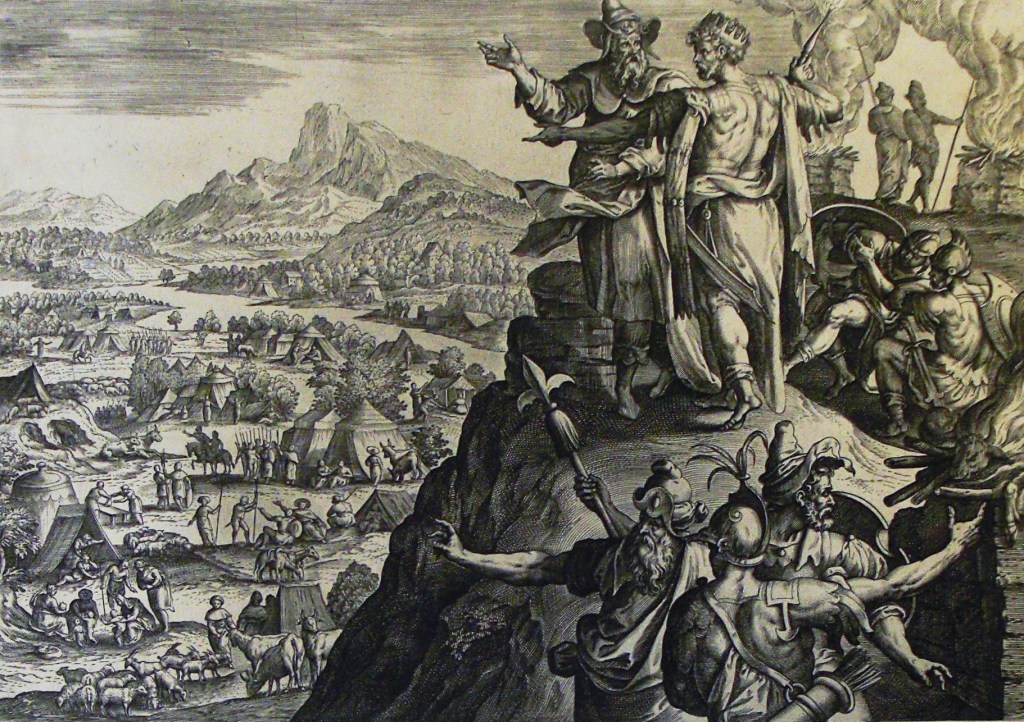
Balak’s Sacrifices, Phillip Medhurst, 1970.
Numbers 22:5 Balak, the King of Moab sent messengers to Balaam to summon him, saying, 6 “Come now, curse this people for me, perhaps I shall be able to defeat them and drive them from the land, for I know that whomever you bless is blessed, and whomever you curse is cursed.”
9 God came to Balaam and said, “Who are these men with you? 12 You shall not go with them; you shall not curse the people, for they are blessed.” 13 So Balaam rose in the morning and said to the officials of Balak, “Go to your own land, for Yahweh has refused to let me go with you. 18 Although Balak were to give me his house full of silver and gold, I could not go beyond the command of the Yahweh my God, to do less or more.
Although Balaam might appear as a faithful prophet of Yahweh on first reading, this is not the whole story. Ancient Jewish and Christian interpreters unanimously viewed him as a villain.
The story of Balaam is told in Numbers 22-24. The King of Moab summons Balaam to curse Israel, hoping to conquer them (Num 22:5-6). Balaam, intending to curse Israel, consults Yahweh (vv. 9-11), but is told to bless Israel instead (v. 12). Balaam is faithful to Yahweh’s message, refusing to curse Israel, despite the promise of riches (v. 18).
A surface reading suggests Balaam was a faithful prophet. One who chose to obey Yahweh and bless Israel, despite the pressures of the world. However, interpreting Balaam as a saint conflicts with the picture we get when reading the rest of scripture.
The Biblical Conflict
Joshua 13:22 The Israelites also put to the sword Balaam son of Beor, who practiced divination.
Balaam was killed by the Israelites (Num 31:8, Josh 13:22) and portrayed negatively throughout the rest of the Bible. He is remembered not as a hero but an enemy of the people of God.
As the Lexham Bible Dictionary notes, “The portrayal of Balaam in Num 22–24 as one who blesses Israel contrasts with negative images of him in other texts. Some passages indicate that Balaam used divination to try to curse Israel, but Yahweh either refused to listen to him (Deut 23:5) or forced him to bless Israel instead (Josh 24:9; Neh 13:2).” (Libby Ballard. “Balaam” LBD, 2016).
Deuteronomy 23:5 Your God refused to heed Balaam; Yahweh your God turned the curse into a blessing for you, because the LORD your God loved you.
These conflicting portraits present Balaam as both a faithful prophet and an enemy of Israel. What are we missing that the ancient Israelites knew?
The Balaam of Archaeology
In 1967, an 800 BC Canaanite inscription was discovered bearing the name: The Book of Balaam, son of Be’or, seer of the gods. In the story, Balaam visits the divine council and prophesies for Canaanite gods—making him an idolater from an Israelite perspective, not a follower of Yahweh (you can view a translation here).
“The book of Balaam son of Beor; he was a seer of the gods. And the gods came to him at night and he saw a vision like an oracle of god… And he said to them, Sit, I shall tell you what the Shaddayin have done; and come, see the deeds of the gods: The gods met together, and the Shaddayin stood up in session.” – “The Balaam Text from Tell Deir ‘Allā”, in Old Testament Pseudepigrapha: More Noncanonical Scriptures, 2013, pg. 355.
Balaam may have been a “prophet for hire”, prophesying for whatever god spoke to him or whoever paid him. This explains why the king of Moab sought his services. Balaam was hired to curse Israel and had every intention of doing so.
Ancient Irony
For ancient Israelites, Balaam wasn’t a faithful prophet of Yahweh, choosing to bless Israel. He was an enemy prophet restrained by Yahweh, unable to curse Israel despite his best efforts.
As Ballard observes, “The story in Num 22-24 would have had an ironic tone to its original readers: the great diviner Balaam, servant of the non-Israelite gods, is in fact controlled by Yahweh.” (Libby Ballard. “Balaam” LBD, 2016).
The New Testament reinforces this view, with Jude, Peter and John comparing false teachers with Balaam. They characterize him as one who does wrong for reward (2 Pet 2:15-16, Jude 11) and teaches others to commit idolatry and sexual immorality (Rev 2:14-15).
Balaam exemplifies not faithful prophesy but God’s sovereign power. Those who come against his people have Yahweh standing in their way. Just as Leviathan (representing chaos) is tamed and domesticated by Yahweh (see Yahweh’s Pet Dragon), Balaam—the ultimate pagan prophet—is silenced, unable to speak a word but what Yahweh allows.
Recommended Reading:
Ballard, Libby. “Balaam, Son of Beor.” The Lexham Bible Dictionary, edited by John D. Barry et al., Lexham Press, 2016.
Balogh, Amy L. “Deir Alla Inscription.” The Lexham Bible Dictionary, edited by John D. Barry et al., Lexham Press, 2016.
Coats, G. W. “Balaam: Sinner or Saint?” Biblical Research, vol. 18, 1973, p. 1-9.
Dijkstra, Meindert. “Is Balaam Also among the Prophets?” Journal of Biblical Literature, vol. 114, Society of Biblical Literature, 1995, p. 43-65.
Hackett, Jo Ann. “Balaam (Person).” The Anchor Yale Bible Dictionary, edited by David Noel Freedman, vol. 1, Doubleday, 1992, p. 569-572.
Hackett, Jo Ann. “Deir Alla, Tell: Texts.” The Anchor Yale Bible Dictionary, edited by David Noel Freedman, vol. 2, Doubleday, 1992, p. 129-130.
Thoughtful and challenging comments or questions are invited and appreciated!
 The New Jerusalem
Leave a comment