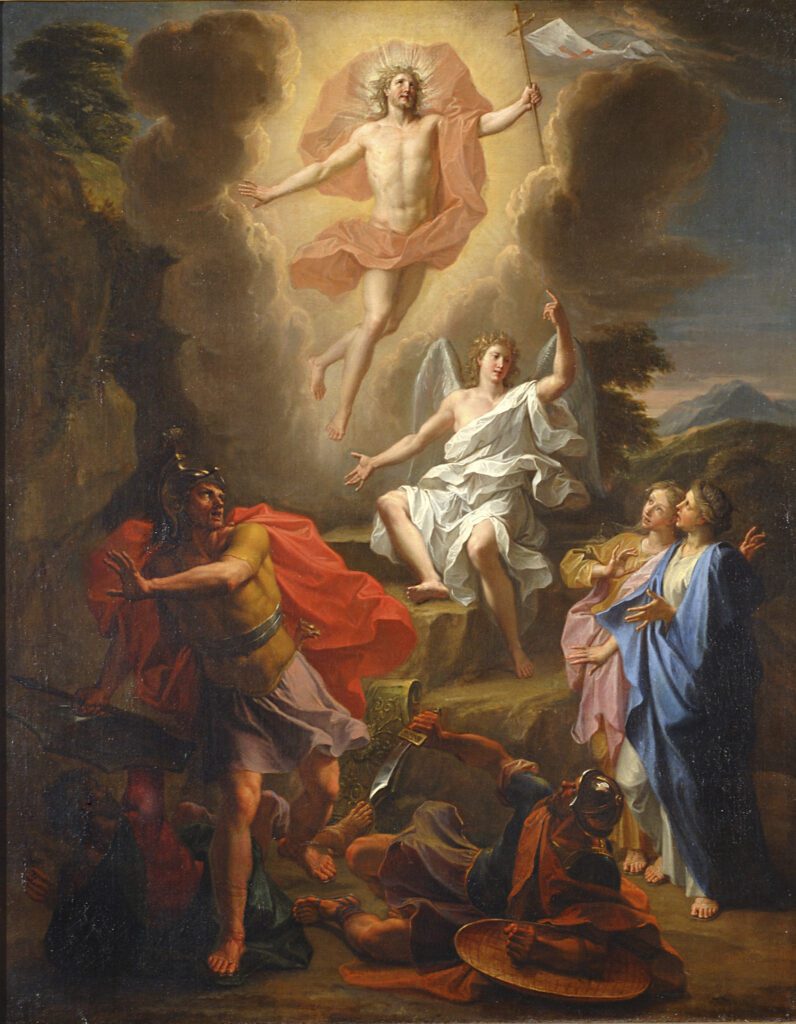
The Resurrection of Christ, Noël Coypel, 1700.
In an era of global uncertainty, many people wonder if we’re approaching the end times. I have vivid childhood memories of distraught church members expressing fear that we were dangerously close to the end times. Some even became doomsday preppers.
With a global pandemic in the rearview mirror and the growing threat of geo-political conflict, this assessment shouldn’t surprise us. Would the early church have thought the same if they were alive today? What does the biblical perspective reveal about the end times?
The Jewish Perspective
For first-century Jews, the end times were characterized by Yahweh’s dramatic intervention in history. God would come, along with his Messiah, and would set things right. One of the most important events that would signify the end of the present age, as well as the beginning of new creation, was the resurrection of the dead. At the dawn of the final era of humanity, Yahweh would raise those belonging to him from the dead (Isa 26:19, Dan 12:1-3, John 11:24, Acts 23:6, 24:15).
“‘Day of YHWH’, ‘Kingdom of God’, victory over evil and pagan rulers, rescue of Israel, end of exile, the coming of the Messiah, the new Exodus, and the return of YHWH himself; and, in and through all of this, the resurrection of the dead. This is the combination of themes which characterizes the first-century Jewish expectation of the future.” – Tom Wright, Paul: Fresh Perspectives, 2005, p. 135.
Jesus and the Resurrection
Jesus reinforced this picture, teaching that the dead would soon be resurrected. Those who rise would enter into the resurrection of life or judgement.
John 5:25 Very truly, I tell you, the hour is coming and is now here when the dead will hear the voice of the Son of God, and those who hear will live.
John 5:28 Do not be astonished at this, for the hour is coming when all who are in their graves will hear his voice 29 and will come out: those who have done good to the resurrection of life, and those who have done evil to the resurrection of condemnation.
Here he is in complete agreement with Jewish thought, adding nothing new. Except that he soon began to speak of himself as going to be killed and rising from the dead. The disciples, knowing that the resurrection was a future and communal event, have no framework to comprehend what he means.
Mark 9:9 Jesus ordered them to tell no one about what they had seen, until after the Son of Man had risen from the dead. 10 So they kept the matter to themselves, questioning what this rising from the dead could mean.
Mark 9:31 He was teaching his disciples, saying to them, “The Son of Man is to be betrayed into human hands, and they will kill him, and three days after being killed, he will rise again.” 32 But they did not understand what he was saying.
“As orthodox Jews, resurrection at the last day was no problem to them: but clearly the words of Jesus here referred to some earlier event, and this puzzled them greatly.” – R. Alan Cole, Mark. TNTC, 1989, p. 217.
When Jesus suffers death and is buried, the disciples still do not understand. Since an individual’s resurrection was not considered a possibility for a first century Jew, a crucified Messiah meant game over. To his followers, Jesus’ death was no exception. The disciple on the Emmaus road says it well, “we had hoped that he was the one to redeem Israel” (Luke 24:21) with the implication that their hope was misplaced.
After three days, Mary Magdalene and the others discover the tomb empty and are told by angels that he has been resurrected from the dead. Yet, the disciples are still unable to comprehend what has occurred. “These words seemed to them an idle tale, and they did not believe them.” (Luke 24:11)
Despite their reluctance to believe, the disciples’ worldview is turned upside down when Jesus appears bodily. Initially, they can only fathom Jesus to be a ghost. It isn’t until Jesus shows the wounds in his hands and feet that they understand. Even then, some doubt until he eats a meal.
Luke 24:36 While they were talking, Jesus himself stood among them and said, “Peace be with you.” 37 They were startled and terrified and thought that they were seeing a ghost. 39 He said to them, “Look at my hands and my feet; see that it is I myself. Touch me and see, for a ghost does not have flesh and bones as you see that I have.” 41 Yet for all their joy they were still disbelieving and wondering, and he said, “Have you anything here to eat?” 42 They gave him a piece of broiled fish, 43 and he ate in their presence.
To their surprise, the resurrection had come early. What God had promised to do for all the saints at end of time, he had done for Jesus in their own day. The disciples know what Jesus’ resurrection means. Jesus had brought the end times to them. The disciples expect other end-times events to come soon, asking “Lord, is now the time when you will restore the kingdom to Israel?” (Acts 1:6).
The Last Days
Soon after, the spirit comes at Pentecost. Peter realizes that this was foretold by the Prophet Joel to occur “in the last days”. Since Easter morning 33 AD, we have all been living in the last days.
Acts 2:16 This is what was spoken through the prophet Joel: ‘In the last days it will be, God declares, that I will pour out my spirit upon all flesh, and your sons and your daughter’s shall prophesy.’
Other New Testament authors share this understanding. According to Paul, Jesus’ resurrection is the “first fruits of those who have fallen asleep” (1 Cor 15:20). What happened to Jesus will happen to all of us. In Matthew’s gospel this is carefully illustrated by picturing the dead raised at the moment of Jesus’ death and resurrection. “The tombs also were opened, and many bodies of the saints who had fallen asleep were raised” (Matt 27:52).
“Matthew appears to be emphasizing the significance of Jesus’ death and resurrection as the dawn of the final era of humanity, which is marked by resurrection—God’s power over death itself” – Faithlife Study Bible, 2016.
Conclusion
Back to our original question. The world feels like it’s falling apart. Are the end times right around the corner, with Jesus’ return imminent? Yes, we are in the last days, just as we have been since Jesus’ resurrection. Jesus resurrection brought the end times to us, a time characterized by Yahweh’s interaction in history.
So where does this leave us? We can live today knowing that we are in the home stretch, the light is at the end of the tunnel. Yet, our response is not fear, but hope-filled action. While Jesus’ resurrection signified the last days, it also began the transformation of the present world. “The present form of this world is passing away” (1 Cor 7:31) and will become the new heavens and the new earth (Rev 21).
Jesus has been given all authority on heaven and earth. He invites us to make disciples of all nations, participating in the restoration of the earth (Matt 28:18-20). Jesus is with us in these last days, to the end of the age, when God promises to bring his dwelling with us.
Revelation 21:3 Behold, the dwelling place of God is with man. He will dwell with them, and they will be his people, and God himself will be with them as their God. 4 He will wipe away every tear from their eyes, and death shall be no more, neither shall there be mourning, nor crying, nor pain anymore, for the former things have passed away.
Recommended Reading:
N.T. Wright, Surprised by Hope, 2007.
Thoughtful and challenging comments or questions are invited and appreciated!
 The New Jerusalem
Leave a comment