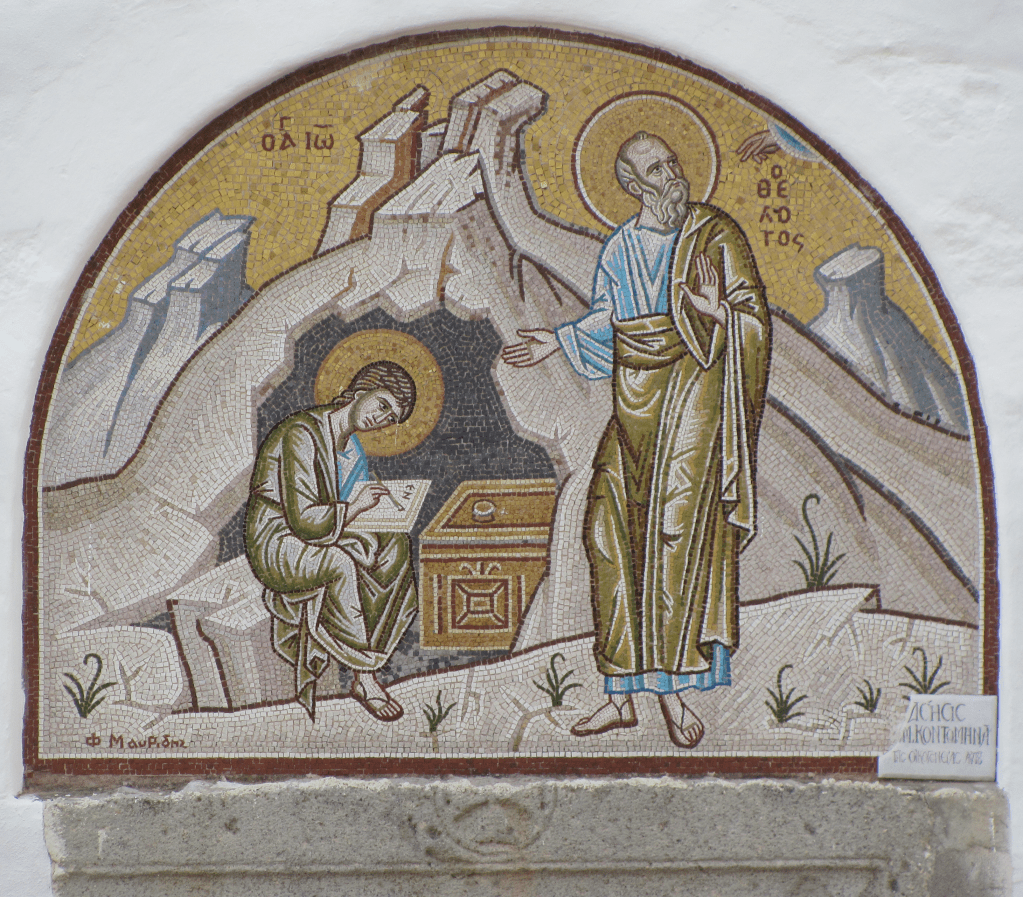
Mosaic of John and Prochorus, Cave of the Apocalypse.
In Church, Art, and popular media, Jesus is often envisioned with only a few close followers: the twelve and a couple women. However, Jesus had many disciples outside the twelve, with only some of their names coming down to us. While we often view it simplistically, Jesus’ followers were a complex group composed of many voices. Examining ancient writers reveals details of those who have often been forgotten yet testify to their enduring witness.
Papias and the Eyewitnesses
Biblical scholars have long studied the writings of a man named Papias. Papias was one of the first Christian writers outside the New Testament, living between 60-130 AD. As bishop of Hierapolis near the turn of the century, he spoke to those who knew the disciples of Jesus personally. His practice was to interview the disciples of the disciples, documenting what they had heard directly from the first followers of Jesus.
Mentioning these disciples, Papias writes, “If ever anyone came who had followed the elders, I inquired into the words of the elders, what Andrew or Peter or Philip or Thomas or James or John or Matthew or any other of the Lord’s disciples had said, and what Aristion and the elder John, the Lord’s disciples, were saying.” – Papias, Quoted by Eusebius, Ecclesiastical History 3.39.4, AD.
Reading the list carefully reveals two groups of disciples. The first group contains Andrew, Peter, Philip, Thomas, James, John and Matthew, the familiar names among the twelve apostles. The second group contains Aristion and the elder John. Both groups are separately specified as “the Lord’s disciples”. Why does Papias distinguish between these two groups?
The key is in the past and present tense verbs that Papias uses. Papias uses the past tense (had said) for what he inquired concerning the first group, the familiar apostles. But he uses the present tense (were saying) for the second group, Aristion and John the Elder, who were still alive and teaching.
As Bauckham observes, “At the time of which Papias is speaking, [the apostles] were already dead and Papias could learn only what they had said… whereas Aristion and John the Elder were still teaching and Papias could learn from their disciples what they were (still) saying.” – Richard Bauckham, Jesus and the Eyewitnesses. 2006, p. 17.
Around 90 AD, nearly 60 years after Jesus’ crucifixion, the twelve apostles, among other disciples of Jesus, had died. However, still remaining were a couple of elderly disciples who, despite their old age, were still witnessing to the gospel. As the last living eyewitnesses of Jesus’ ministry, Aristion and the elder John held an unrivaled authority at the end of the first century.
Two Johns?
In Papias’ list of disciples, the name “John” is present twice. Once in the first group and once in the second group. The first must refer to John son of Zebedee, one of the twelve apostles. The second, distinguished by the title “the elder,” must be some other disciple of Jesus. While his name may be unknown to us, Papias’ lack of elaboration takes for granted that he was a well-known disciple of the Lord in his time.
As the early church historian Eusebius writes, “It is here worth noting that he twice counts the name of John, and reckons the first John with Peter and James and Matthew and the other Apostles… but places the second with the others outside the number of the Apostles, putting Aristion before him and clearly calling him an elder.” – Eusebius, Hist. Eccl. 3.39.5.
We conclude with the early church scholar Jerome that, “It is obvious from this catalogue of names that the John who is listed among the apostles is not the same as the elder John whom he numbers after Aristion.” – Jerome, On Illustrious Men 18.3, 393 AD.
John the Disciple of the Lord
As we noted earlier, John the Elder was a personal disciple of Jesus and eyewitness of his ministry. Indeed, he was among the last disciples of Jesus still alive in the 80s and 90s. Many readers are surprised to learn that Jesus had disciples outside of the twelve that are unmentioned in the Gospels. However, Jesus had many disciples that are never identified by name (Matt 8:21-22, Mark 14:51-52): Cleopas’ companion (Luke 24:13) the seventy (Luke 10:1), the 500 (1 Cor 15:6) and apparently Aristion and the elder John.
While it may surprise us that Jesus would have two disciples named John, this was quite common in first century Palestine. John was the 5th most common name during this period, so it shouldn’t surprise us that Jesus had two disciples with that name. Other common names also appear multiple times among Jesus’ disciples. Jesus had two disciples named James, Judas, and Simon, so why not John?
The Elder
In the passage we have discussed, Papias calls John “the Elder” to distinguish him from the son of Zebedee. What does this title mean?
Scholars have concluded that “The elders were the senior Christian teachers in the cities of Asia at the time of which Papias writes.” (Bauckham. The Gospels, 421). They were “members of the older generation who are regarded as mediators of the authentic tradition and reliable teachers.” (Günther, “Πρεσβύτερος.” TDNT, 1964, p. 676).
By around 90 AD, the Apostles had died, leaving the second-generation elders as the foremost Christian teachers. While the first-generation Christians had largely passed away by this time, John was still alive. As the sole elder that witnessed Jesus, he had an unparalleled spot among them, head among the elders. As one of the last living disciples, John was advanced in years, probably between 75-85 years old.
The Elder, then, has a double meaning. It places John as one of the senior Christian authorities and also serves to indicate his age and therefore “direct link” with the ministry of Jesus. In this way, John came to be known as the Elder, such that no qualification was needed.
“The reason why this John was called the elder… [is that] in his person great age was combined with strong authority.” – Martin Hengel, The Johannine Question. 1989, pg. 80.
The title “the elder” alongside the name “John” corresponds rather strikingly with the epistles of John, whose author calls himself simply “The Elder” without qualification. To Christians living at the end of the first century, “the Elder” would be a clear reference to this other John.
Conclusion
The testimony of the early church opens a window into the rich complexity of Jesus’ first followers, including many who have been lost to history, yet whose witness was vital to the early Christians. John the Elder stands as a remarkable figure among these forgotten disciples. As the last remaining disciple of Jesus and a senior teacher in the church, John had a unique and unparalleled position.
John reminds us that the church, from its earliest memories (moments), was far more diverse, extensive, and complex than we imagine. Behind the familiar names recorded in the New Testament stands a “great cloud of witnesses” whose testimony impacted the faith that was passed down to us. The foundation of the church rests not only on the twelve, but on the many who witnessed, believed, and testified to what Jesus had done for them.
Recommended Reading
Martin Hengel. The Johannine Question. Trinity Press, 1989.
Richard Bauckham. Jesus and the Eyewitnesses: The Gospels as Eyewitness Testimony. Eerdmans Publishing Company, 2006.
Richard Bauckham. The Testimony of the Beloved Disciple: Narrative, History, and Theology in the Gospel of John. Baker Academic, 2007.
Dean Furlong. The Identity of John the Evangelist: Revision and Reinterpretation in Early Christian Sources. Fortress Academic, 2020.
C. F. Burney, The Aramaic Origin of the Fourth Gospel. Oxford Press, 1922, pg. 133-49.
B. H. Streeter. The Primitive Church. Macmillan and Co, 1928, pg. 89-97.
Thoughtful and challenging comments or questions are invited and appreciated!
 The New Jerusalem
Leave a comment