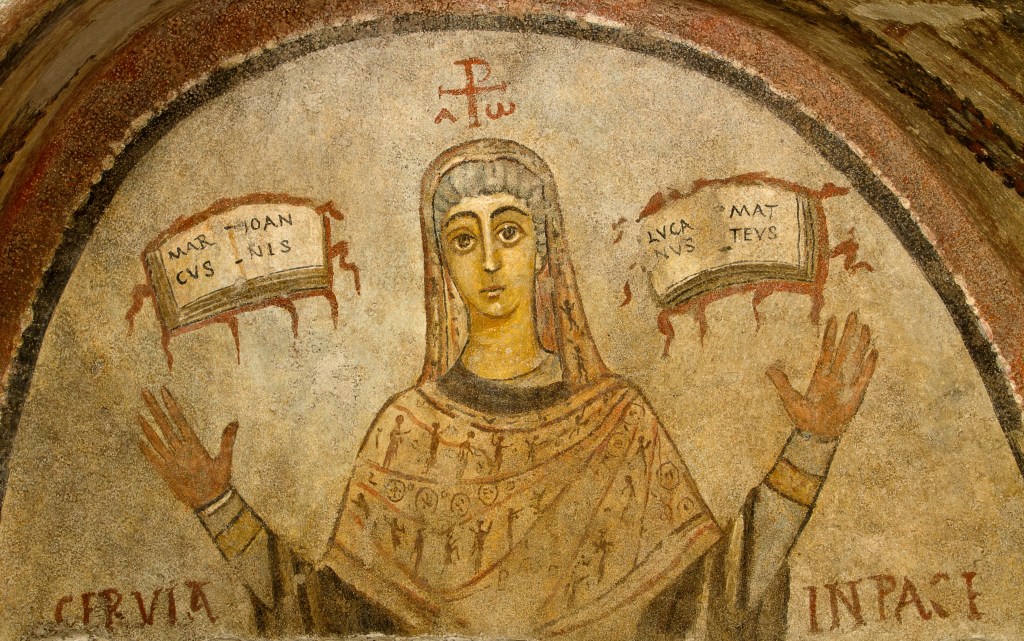
Fresco of Cerula, Catacombs of San Gennaro, late 5th Century.
The Epistle to the Romans is one of Paul’s most complex and profound works. After 15 chapters of dense theology, many readers tend to skim over chapter 16, a list of personal greetings to the Roman church.
Yet within this overlooked chapter lies a remarkable discovery that may challenge common assumptions about church leadership. Romans 16 gives us a rare window into the life of the early church. These candid statements by Paul preserve a historical record of what the Roman church looked like.
After greeting some church leaders and personal converts, Paul greets Andronicus and Junia, who are likely a ministry couple similar to Priscilla and Aquila. Remarkably, Paul declares that they are ἐπίσημοι ἐν τοῖς ἀποστόλοις, that is, prominent among the apostles.
Romans 16:7 Greet Andronicus and Junia, my fellow Israelites who were in prison with me; they are prominent among the apostles, and they were in Christ before I was.
For those accustomed to exclusively male church leadership, finding a female apostle in Paul’s letter is startling. Evidently, Paul saw no problem with a woman holding the office of Apostle. He not only acknowledges her apostleship but describes her as outstanding among them, challenging the notion that women are to be excluded from leadership in the church.
Investigating Apostleship
When we hear “apostle”, many think of the twelve. In the New Testament, however, many outside of the twelve are called ἀποστόλοις, including: Paul (1 Cor 9:1), Barnabas (Acts 14:14; 1 Cor 9:5-6), Silvanus (1 Thess 2:6-7), James (Gal 1:19), the 70 (Luke 10:1) and others (1 Cor 15:6-7, Eph 2:20). What is an ἀπόστολος for Paul?
Άπόστολος derives from the verb ἀποστέλλω (to send out). At it’s most fundamental level, ἀπόστολος means “sent one”. In secular literature it often refers to naval vessels. For the early Christians, however, the word takes on a specific & personal meaning. For Paul, an ἀπόστολος wasn’t just any messenger, but someone who had been sent by the risen Jesus (1 Cor 9:1, 15:7) for the express purpose of proclaiming the gospel.
“When Paul defends his apostleship—and thereby defines what apostleship means—he implies that to be an apostle involves encountering the risen Christ (1 Cor 9:1; Gal 1:1, 15-17) and receiving a commission to proclaim the gospel (Rom 1:1-5; 1 Cor 1:1; Gal 1:1, 15-17)” – Eldon Jay Epp, Junia: The First Woman Apostle, 2006, pg. 70.
As Apostles, Andronicus and Junia must have encountered the risen Jesus, likely during the 40 days between Jesus’ death, resurrection and ascension. Just as Jesus had commissioned the other Apostles, he also commissioned Andronicus and Junia to proclaim what they had seen: the risen Lord. Their fulfillment of this task would likely have invited persecution and it is no surprise that Paul affirms that he had been in prison with them.
“The unqualified ‘the apostles’ of Romans 16:7 must refer to the apostles of Christ, whom Paul generally refers to simply as ‘apostles.’ For Paul, the apostles of Christ included not only the twelve but also Barnabas (1 Cor 9:6), the brothers of the Lord (Gal 1:19; 1 Cor 9:5), probably Silvanus/Silas (1 Thess 2:7), and perhaps Apollos (1 Cor 4:9), as well as Paul himself. These are those who had been commissioned by the risen Christ himself in resurrection appearances, since it is in this sense that Paul can regard himself, the last to be so commissioned, as the least of the apostles (1 Cor 15:9; cf. 9:1).” – Richard Bauckham. Gospel Women. 2002, p. 180.
In Luke, “ἀποστόλοις” typically refers to the twelve appointed by Jesus. For Paul, however, the apostles are a broader group than the twelve. This is made explicit in 1 Cor 9:5-7 when Paul writes that Jesus “appeared to the twelve… Then he appeared to James, then to all the apostles”. While the twelve are certainly apostles, not every apostle is among the twelve, according to Paul.
“Precisely because of the seriousness with which he defends his own claim to apostleship (Gal 1:1, 11; 1 Cor 9:1), we must assume that he recognized others as apostles only when he was convinced that their own apostolic charge had also come from the risen Lord (cf. 1 Cor 15:7)” – Bernadette Brooten, Women Priests, 1977, pg 141-144.
The Search for Junia
Andronicus and Junia were Jewish converts to Christianity in the foundational years of the church. They had been imprisoned and persecuted alongside Paul and had earned the reputation of prominent apostles. With such a resume, they would have been well-known leaders in the early church.
It seems strange that these “prominent apostles” are mentioned nowhere else in the New Testament. To resolve this, two possibilities have been suggested. It may be that they were part of the seventy-two apostles sent by Jesus in Luke 10:1 or the 500 that Christ appeared to in 1 Cor 15:6-7.
“It can also be understood that perhaps they were of the seventy-two, who themselves were also named apostles, and on that account he would call them noble among the apostles, even among those apostles who were before him.” – Origen, Commentary on Romans 10.21.2. 236 AD.
“They belonged most probably to the closed group of apostles appointed directly by the risen Christ in a limited period following his resurrection (1 Cor 15:7). We may firmly conclude that one of the foundation apostles of Christianity was a woman and wife.” – James Dunn, WBC on Romans 9-16. 1991, pg. 894-895.
However, there is another possibility. It has been recently suggested that Junia may have been a member of the very first apostles: those who witnessed Jesus’ resurrection on Easter Sunday. The women at Jesus’ tomb both witness the risen Christ and were commissioned to tell others (Matt 28:7-10), making them the prototypical apostles. These women include Mary Magdalene, the other Mary, Joanna and others (Luke 24:10).
Some scholars argue that Junia might actually be Joanna who adopted a Roman name. It was a known practice for Jews to adopt Greek or Latin names, often choosing a name similar in sound to their Hebrew name. In the New Testament, examples include Saul/Paul (Acts 13:9), Silas/Silvanus, Joseph/Justus (Acts 1:23) and Jesus/Justus (Col 4:11).
This often occurred when the person’s Semitic name was common and required distinguishing. It may also have been done when the Semitic name was difficult to pronounce by foreigners. In this case, both apply. Joanna is the fifth most common name among Palestinian Jews at this time and the Hebrew form Yəhōḥānnā would have been difficult to pronounce by foreigners. The sound-equivalence of Joanna and Junia makes the identification plausible.
“Her Hebrew name was an awkward one for Greek-or Latin-speakers. She may have adopted the Latin sound-equivalent of her Hebrew name when she became a Christian missionary in Rome, where Junia was a common female name.” – Richard Bauckham. Gospel Women. 2002, pp. 185–86.
Junia’s Significance
Regardless of their history, it is clear that Paul recognized Andronicus and Junia as Apostles, and prominent ones at that. While the presence of a female Apostle may challenge modern assumptions of the “proper role” of women in ministry, it posed no problem for Paul. Rather than imposing our own regulations on Junia, we must allow the New Testament to teach us what role women played in the early church.
“It remains a fact that there was a woman apostle, explicitly so named, in the earliest generation of Christianity, and contemporary Christians must (and eventually will) face up to it.” – Eldon J. Epp, Junia: The First Woman Apostle. Fortress Press, 2005, 81.
Recommended Reading
Jared Matthews, Is Junia an Apostle? The New Jerusalem, 2025.
Eldon Jay Epp, Junia: The First Woman Apostle. Fortress Press, 2005.
Richard Bauckham, Gospel Women: Studies of the Named Women in the Gospels. William B. Eerdmans Publishing Company, 2002, pp. 165–202.
Shane Rosenthal, Luke’s Key Witness. The Humble Skeptic, 2025.
Ben Witherington III, Paul’s Letter to the Romans: A Socio-Rhetorical Commentary. William. B. Eerdmans Publishing Co., 2004, p. 387-393.
Linda Belleville, “A Re-examination of Romans 16.7 in Light of Primary Source Materials.” New Testament Studies 51, no. 2. 2005, 231-249;
Joseph Fitzmyer, Romans. Anchor Bible Commentary. Doubleday, 1993, pg 737-739
Thoughtful and challenging comments or questions are invited and appreciated!
 The New Jerusalem
Leave a reply to stillstoriesblog Cancel reply